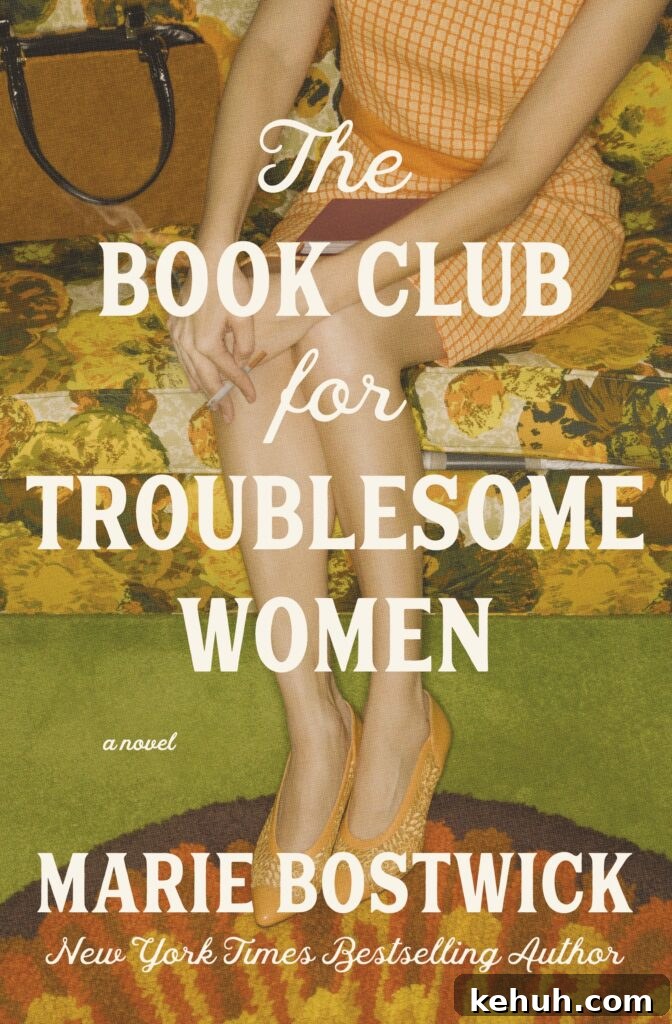
My new novel, The Book Club for Troublesome Women, is finally on bookstore shelves, and I’m thrilled to introduce readers to Margaret, Charlotte, Viv, and Bitsy — four women whose lives and voices have become very real to me.
These women are best discovered in the pages of the book, but for readers who want a little context before diving in, or who are deciding whether to pick it up, I’m sharing an excerpt from an interview I gave to HenLitCentral.com.
Troublesome Women Q&A Excerpt
Can you tell us a bit about yourself and an overview of your new book The Book Club for Troublesome Women?
I live in Washington state with my husband and our somewhat spoiled Cavalier King Charles Spaniel. I’ve written more than twenty novels, and my latest, The Book Club for Troublesome Women, follows four dissatisfied housewives from the 1960s who question why “having it all” — kids, spouse, and a suburban home — still leaves them feeling empty.
When Charlotte Gustafson, an intriguing, artsy, and irreverent new neighbor, moves in, Margaret Ryan decides to form a book club to get to know her. At Charlotte’s suggestion, the first title they tackle is Betty Friedan’s 1963 landmark work, The Feminine Mystique. That choice alters the course of their lives.
Calling themselves the Bettys in tribute to Friedan, the women don’t realize that their spontaneous book club and the books they read together will become the bond that carries them through tears, triumphs, tensions, and breakthroughs — and will lead them to the most liberating year of their lives.
What inspired you to set The Book Club for Troublesome Women in the 1960s, and how did you approach capturing the essence of that era?
The inspiration came from a conversation with my mother, who told me that The Feminine Mystique changed her life. Hearing how Friedan’s book affected her and her friends made me realize this was the story I wanted to write.
Capturing the 1960s was helped by the fact I was alive then — I remember the era’s small but telling details: ashtrays on tables because people smoked indoors, Tang and Captain Crunch as an acceptable child’s breakfast, three television networks with Walter Cronkite as the trusted anchor, and the prevalence of Danish modern furniture. Those textures add authenticity.
I also did extensive research: reading books about the period, collecting vintage women’s magazines, and spending many hours online. Most importantly, I kept talking with my mother to understand the frustrations and limitations her generation faced and what it felt like to push past them.
The characters in the book form a deep bond through their book club. How did you develop individual stories, and what message do you hope your readers will take away?
Writing ensemble casts has long been a focus of my work. To create distinct but connected stories for four very different women, I start with the basics — age, birthplace, appearance, marital status, education — then dig deeper. I examine formative memories, fears, pride, and secrets. I ask two central questions for each character: What do they want most? What prevents them from achieving it?
Those answers shape personalities and plotlines, revealing intersections that feel natural and meaningful. In The Book Club for Troublesome Women, the differences among the women highlight a central theme I hope resonates with readers. One passage, written by Margaret, captures the heart of the book:
“There are countless good and right ways to be a woman and only two wrong. The first is to insist that your way is ‘the’ way, the only way. The second is to buy into that nonsense and to spend your life limping along an aimless path in shoes that will never fit.”
Each of the four women desires something unique and faces different obstacles, yet they share a common longing: the freedom to pursue their own definition of fulfillment. The barrier they confront is cultural — the narrow beliefs that prescribe a single acceptable path for feminine happiness. Although the story is set in the 1960s, that struggle continues to feel relevant today.
Order your copy of The Book Club for Troublesome Women