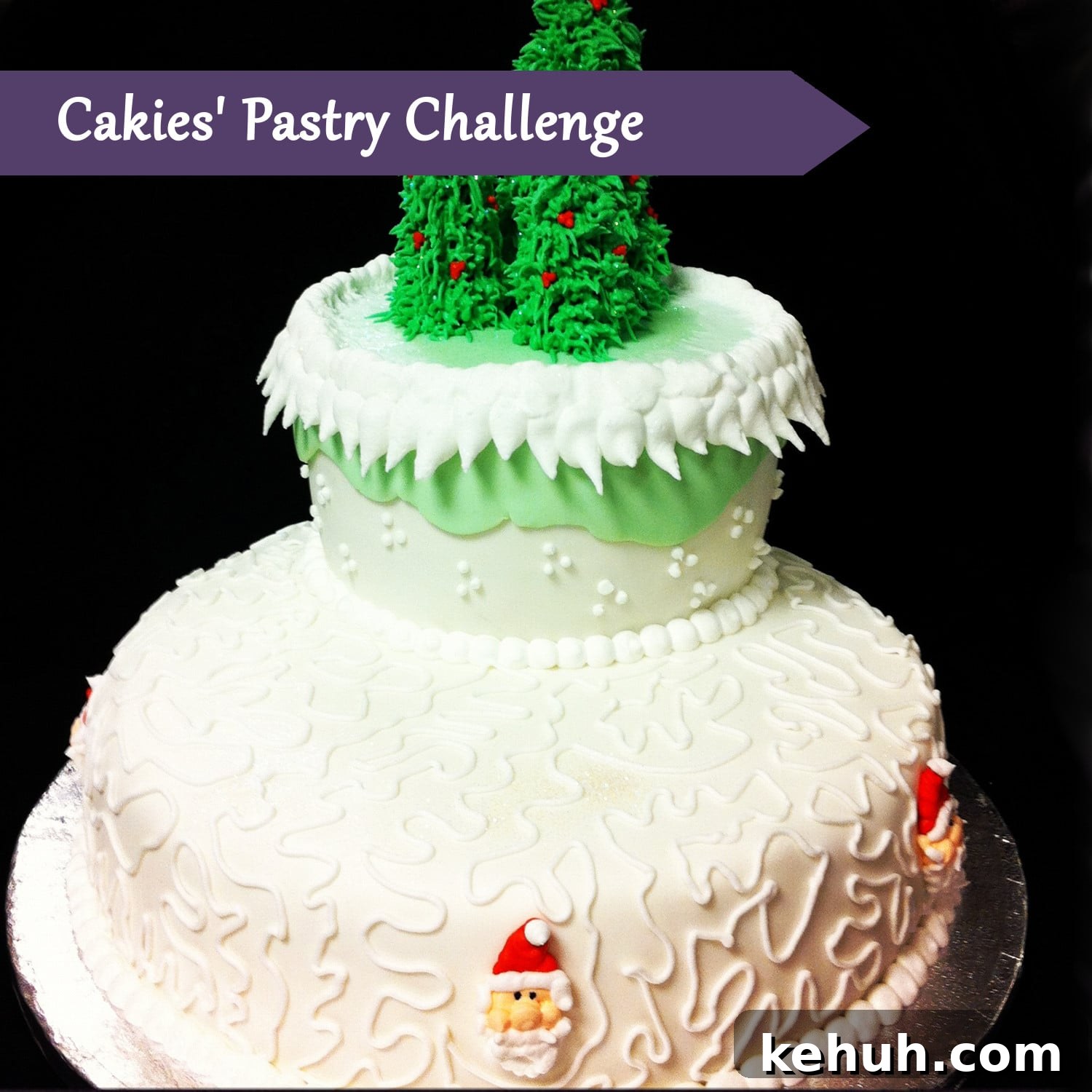
This week was final assignment week. For the third module’s culmination we were tasked with filling and decorating a two-tier cake. I chose to bake both tiers myself, then fill and decorate them in class. As often seems to happen, I ran into a few setbacks: by the time I was ready to fill my cakes, our supply of buttercream had run out, so we had to whip up a fresh batch from scratch. That delay meant I had less decorating time than many of my classmates and had to slightly simplify my original plan.
The first step was to ice the filled layers and cover them with fondant. While some of the group worked on finishing touches, others prepared royal icing for detail work. I covered both tiers in smooth white fondant and added a small green top on the upper tier to introduce a contrasting color. Because time was limited I kept the overall design clean and classic: a few Santa figures, several small Christmas trees, and some decorative piping to tie the elements together. The simpler approach suited the cake well and allowed me to focus on neat execution.
Despite wanting to experiment with more advanced techniques, I’m very pleased with the finished cake. The proportions looked balanced, the fondant was smooth, and the piped details framed the figures nicely. Working under a tighter timeline taught me a useful lesson in prioritizing the techniques that would most improve the cake’s final appearance, rather than attempting too many new skills at once.
The atmosphere in class was supportive and busy: some students tried intricate piping patterns and sugar flowers, while others focused on structure or flavor combinations. Watching different approaches helped me refine my own plan quickly. For future projects I’d like to practice a few more decorative methods—textured buttercream, more intricate royal icing designs, and molded fondant pieces—but for this assignment I was satisfied with a clean, festive look that showcased the cake’s silhouette.
In addition to technical practice, the assignment reinforced practical time management and problem-solving skills. When supplies ran low we adapted and worked efficiently, and when time was short we simplified our designs without sacrificing overall quality. Those are valuable habits to carry forward, both in the kitchen and in larger baking projects.
Looking ahead, I’m eager to discover the next module’s focus. There won’t be new lessons for the next two weeks, so the course picks up again next year. That break gives me time to practice the techniques I couldn’t explore this week and to experiment with more elaborated decorations on smaller practice pieces before the next assignment.
Overall, this final assignment of the module was a rewarding challenge: it combined baking, structure, and decoration while encouraging quick thinking and creative decision-making. I left class feeling proud of the finished two-tiered cake and motivated to expand my skills in the upcoming modules.